
According to this framework, a wisdom-bound organization would need to cover the following features:
Humility.
A practice of not-knowing and acknowledgement of own limitations.
Think of an old tree nourishing all organisms growing on it.
- This can be spiritual, or a VUCA or complex systems mindset.
- Cares about flow of all forms of knowing in a distributed and collective manner.
- Might transcend the boundaries and what we think an organization looks like.
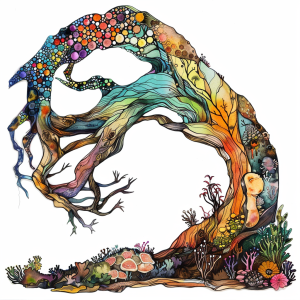
Appreciates all forms of knowing, being and learning
Think of the multitude of ways in which trees “take in” information and nutrients via air, sun, roots, leaves, bark.
- Puts practices in place to support multi-sensory (propositional, procedural, perspectival, and participatory) and relational learning.
- Emphasis on literacy in those practices to use them well and seamlessly.
- Often collective (not solitary) practices or learning from each other.

Deeply connected with its ecosystem, almost indistinguishable from it.
Think of a river that “begins” with raindrops and “ends” in the ocean.
- A purpose bigger than itself. As close to “life itself” as possible.
- Intentional pathways for interconnection with several “outside” groups.
- Ready (and able) to be transformed and molded by its environment, in its parts and in major ways (an organizational “egolessness”).

Emphasis on meaningfulness
Think of a tapestry of different materials.
- Meaningfulness as a measure stick, both for individuals and the collective.
- Creating possibility by connecting what exists. Connecting what “wants to be together”. Like a river that carves its path through the landscape, not by force but by following the path of least resistance
- A commitment to keep the context of people, objects, and information intact.



 Wiser organizations
Leave a comment