
Context
Sociocracy is a governance system that supports organizations in making all the decisions needed to carry out their operations.
The word “sociocracy” was coined by Auguste Comte, a French philosopher, in the mid-19th century. The current practices associated with sociocracy have been put together by Dutch engineer Gerard Endenburg in the Sociocratic Circle Method in the late 1970s. Sociocracy is used as a governance method in various sectors across the world. Read about the movement.
Overview
Sociocracy is a governance system for self-governance. It consists of 3 major areas:
- Decision-making (by consent)
- Distributed power in small, nested, linked circles
- A commitment to and practice of learning and improvement
Other related practices are rounds (the practice of speaking one by one), selections (elections by consent), meeting formats, review and feedback formats (e.g. performance reviews).
Key practices
Consent
Consent is the decision-making method for all team (called circle) policy decisions. The intention of consent is to align all future proposals with the standing agreements and the needs of the team and the organization.
For a consent decision, every circle member is asked for consent. They consent is they see the proposal as aligned with the aim (and standing agreement). They object if they don’t – and then explain why.
The process looks like this:
- Present the proposal and answer questions (understand)
- Reaction round (explore/deliberate)
- Consent round (decide)
Only if there is no objection in the circle does the proposal pass.
Distributed Power in circles and roles
The overall aim of the organization gets “divided up” into smaller aims, carried out in circles. This goes along with a domain – all decision areas are “packaged” in domains which are assigned to circles, creating a situation where each decision is made in a decentralized fashion by a circle somewhere in the system.
Circle aims (what the circle does) and domains (what the circle can make decisions about) are decided in mutual consent with the respective “higher” circle.
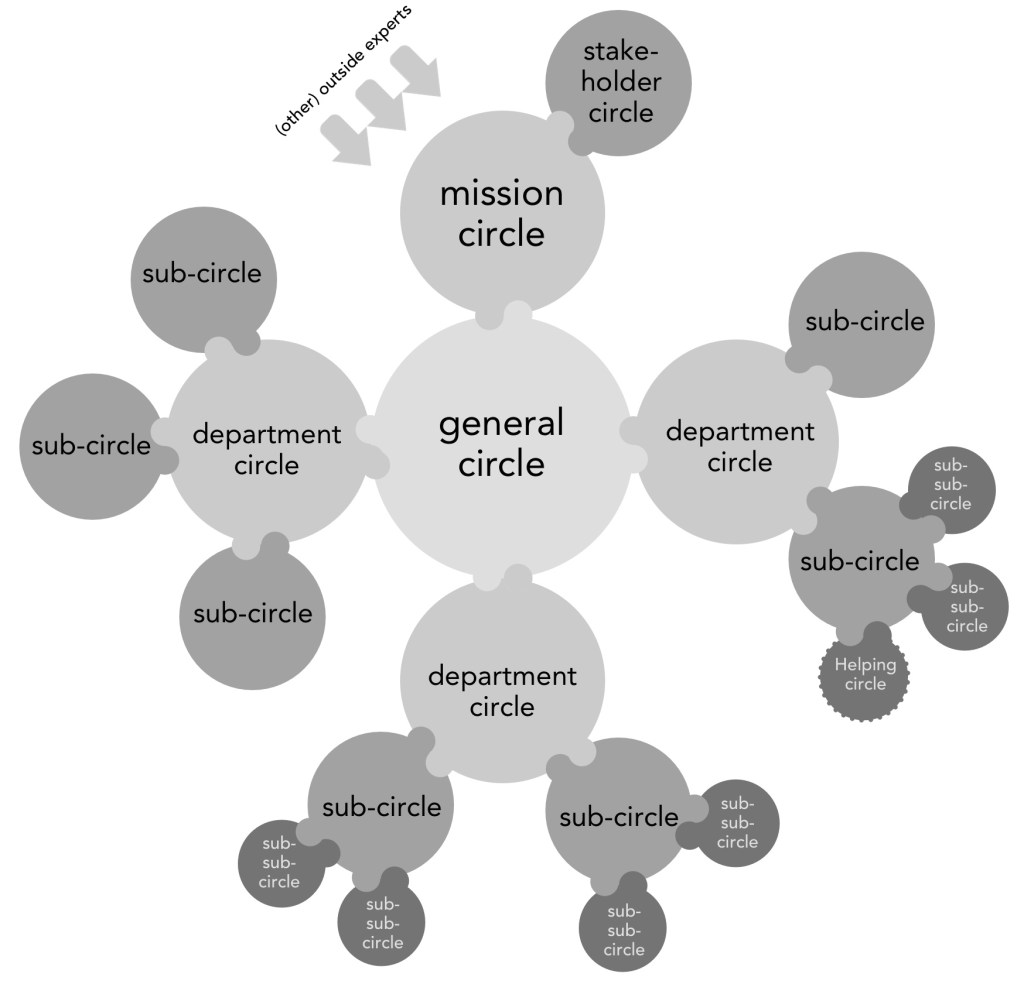
Each related two circles are connected by two people called links. The “top-down” link is the leader, and the “bottom-up” link is the delegate. Both are decision-makers in both circles; they make sure that decisions between related circles remain aligned, and contribute to information flow.
Other roles (e.g. process related like facilitators) and operational roles “package” tasks and functions related to the work and the effective operating as a circle.
Learning and incremental feedback
Several practices are connected to learning and improvement. All decisions come with a term end which enforces a review.
- role reviews
- policy review
- performance review
- meeting evaluations
- …
A general commitment to feedback and learning also lives in how objections are treated in the consent process – as valuable information.
When to use use which process
While all individual tools and practices were originally meant to be practiced together, there is variation to how many of the “core set” are used in a given organization.
The most basic setup is consent as a decision-making method, and a decentralization of authority in domains. The most commonly used tools are rounds, consent process and the meeting format of check-ins, admin, consent to agenda, agenda, meeting evaluation.
Key concepts
- Circle: In sociocracy, organizations are structured into circles or teams, each with its own specific purpose and responsibilities. Circles have a defined domain and autonomy to make decisions within that domain.
- Consent: The decision-making process in sociocracy is based on consent, which means that a proposal is considered accepted unless there are valid objections. Consent is different from consensus, as it does not require everyone to agree but rather to not have any significant objections.
- Double-Linking: This term refers to the practice of having members from one circle participate in the decision-making process of another circle. Double-linking promotes communication and coordination between circles.
- Policy: Sociocracy uses a system of policies to guide decision-making. Policies are clear guidelines, roles or workflows that help circles carry out their operations.
- Selection process: In sociocracy, roles within circles are typically filled through elections by consent, where individuals are chosen based on their suitability for the role, and there are no competitive elections.
- Feedback Loops: Sociocracy emphasizes the importance of regular feedback loops to evaluate and improve processes and decisions. Feedback helps organizations adapt and evolve over time.
- Domain: Each circle or role in sociocracy has a specific domain or area of responsibility. Defining domains helps prevent conflicts and clarify decision-making authority.
Wisdom dimension
- Inference


 Wiser organizations
Leave a comment